Visiting The Uprising Museum in Warsaw has been in my bucket list for a long long time. But I didn’t expect to feel this way.
Museums, even the good ones, maintain a certain respectful distance. You walk through. You read plaques. You feel informed, perhaps moved, and then you step out into the sunlight and check your phone. This one doesn’t work like that.
The Warsaw Uprising Museum grabs you by the collar the moment you walk in. The air changes. The light drops. And then, slowly, 63 days of 1944 begin to speak to you — not as history, but as something far more uncomfortable. As a mirror.
The Map That Started Everything
Before the galleries begin, before the artifacts and the photographs and the ruins under glass, there is a map.
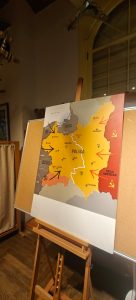
It is displayed on a simple easel. Yellow in the centre — that is Poland. To the left, grey with a swastika: Nazi Germany. To the right, dark red with a hammer and sickle: Soviet Russia. And from both sides, arrows. Large, thick, unmistakable arrows converging on Warsaw from the west and from the east simultaneously.
You look at that map and everything becomes clear in a way that years of history lessons somehow never managed. Poland in 1939 was not invaded. It was consumed. By the two most brutal regimes the twentieth century had yet produced. Working, at that moment, in coordination.
On 1 September 1939, Marshal Śmigły-Rydz, Commander-in-Chief of the Polish Army, issued his order. It is displayed in the 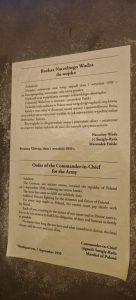 museum, framed and lit, words typed in two languages. “Soldiers! The German, our ancient enemy, invaded the republic of Poland on 1 September 1939, violating our entire border. The time has come to fulfil our soldierly duty.” “No matter how long the war lasts and what casualties it claims, the final victory will be ours and our allies.”
He was writing into the unknown. He could not have known that the war would last six years. That Poland would lose one-fifth of its entire population. That the city he was defending would be systematically demolished, block by block, and then require decades of reconstruction. That the ‘allies’ he invoked would, in the end, hand Poland to a different occupier at Yalta while the world moved on. History is cruel in proportion to how much it is misread before it happens.
The City That Refused to Die
Let us get the history straight first, because without it, nothing else makes sense.
What followed the invasion was five years of systematic annihilation. The Nazis didn’t just want to rule Poland. They wanted to erase it. Warsaw’s Jewish population — over 400,000 people — was herded into a ghetto, starved, and then systematically murdered. The city was turned into a killing ground. Polish intellectuals, priests, teachers — anyone who could carry the flame of nationhood — were targeted. The Pawiak prison, one of the main German detention centres in occupied Warsaw, held approximately 100,000 Poles during the occupation. Nearly 37,000 of them died there — through torture, execution, deportation to concentration camps. The mass executions happened in the forests of Palmiry, just outside the city. The ’roundups’ on Warsaw’s streets were a constant threat, a word in the air like weather.
But underground, something was burning.
The Armia Krajowa — the Home Army — was one of the largest resistance movements in occupied Europe. Hundreds of thousands of members. They ran intelligence networks, smuggled weapons, published underground newspapers, and trained for the day they would fight back openly.
That day came on August 1, 1944. At precisely 5:00 PM — W-Hour — the Uprising began. The timing was calculated and 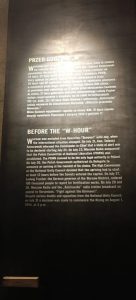 agonised over. The timeline board in the museum lays it out with almost brutal clarity: Pearl Harbor, Stalingrad, Monte Cassino, Normandy — and then: The Outbreak of the Warsaw Rising. 1 August 1944. And then: The End of the Warsaw Rising. 5 October 1944. And then, still later: Soviet Army Enters Destroyed Warsaw.
The sequence tells you everything. The Rising began when the Soviets were close enough to seem like salvation. It ended before they arrived. And when they finally came — they entered a city that had already been destroyed.
For 63 days, the people of Warsaw fought with everything they had. Soldiers, but also teenagers. Women. Poets. Doctors. Nurses. They fought street by street, building by building, floor by floor. And then Stalin — who had paused his army on the eastern bank of the Vistula, watching — refused to allow Allied aircraft carrying supplies to land on Soviet-controlled territory. The Poles bled out without reinforcement, without adequate weapons, and without the relief they had been promised.
On October 2, 1944, the Uprising capitulated. Hitler ordered the total destruction of Warsaw. By the time the Soviets finally entered in January 1945, approximately 85% of the city had been reduced to rubble. Around 200,000 Polish civilians were dead.
The city you see today — beautiful, vital, rebuilt — rose from that rubble, brick by brick, often from memory and old photographs. Warsaw is perhaps the only major European capital that was literally reconstructed after being intentionally destroyed.
This is what you carry into the museum.
Walking Into 1944
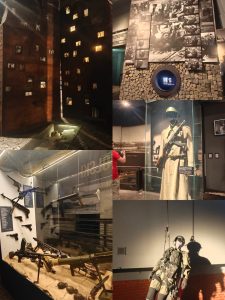
The museum itself is built inside a former tram power station — industrial bones, raw concrete, steel. It doesn’t try to be beautiful. That choice is itself a statement.
The first thing that strikes you is how dark it is. Not moody-dark, but functionally, deliberately dark. The kind of dark that makes you slow down. The kind that makes you look.
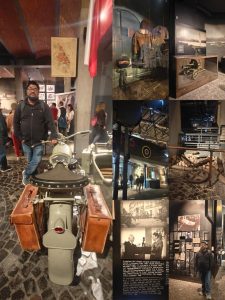
I walked through gallery halls where the walls themselves have been designed to feel like the ruins of Warsaw. Jagged edges of broken brick. Photographs blown up to wall-scale, so large that the rubble and the smoke and the faces seem to exist in three dimensions around you.
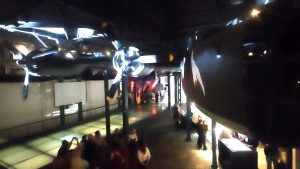
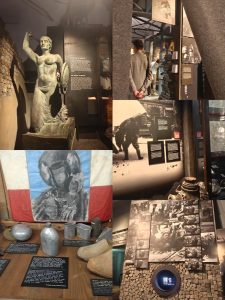
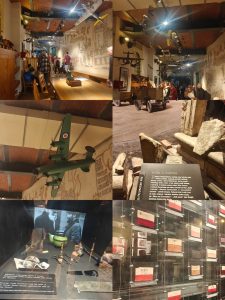
At one point I stood in a narrow corridor — cobblestones underfoot, photographs of soldiers and civilians pressing in from both sides — and looked up. A Polish flag hung above the passage, white and red, suspended in a glass case. People walked beneath it the way you walk under an arch. Quietly. Heads slightly bowed. Nobody asked them to do this. The space simply demanded it.
There is a moment — you’ll know it when it comes — when you stop reading the panels and just stand there. Just look. Because the scale of what you’re seeing doesn’t fit into any ordinary frame of reference.
The Paper That Kept People Alive
There is a display case in the occupation section that you could walk past in thirty seconds. Most people probably don’t stop long enough.
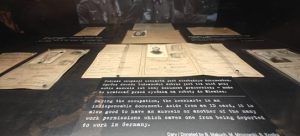
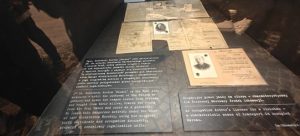
It holds identity documents. Kennkarten. German-issued registration cards, each with a small photograph, each bearing a name, a birthdate, a profession. The museum’s caption is plain: ‘During the occupation, the kennkarte is an indispensable document. Aside from an ID card, it is also good to have an ausweis or another of the many work permissions which saves one from being deported to work in Germany.’
Saves one. Two quiet words.
What they mean, in practice, is this: the difference between walking home and being rounded up on the street. The difference between continuing to exist and being loaded onto a train. A piece of paper with a rubber stamp. Your photograph in the corner. Your name in German script.
And then there are the other documents. The forged ones. The resistance ran clandestine ‘legalization units’ whose sole job was to produce false identity papers. Surnames changed. Professions invented. Photographs of dead men used by living ones. One display tells the story of 2nd Lieutenant Konstanty Kostka, the Home Army’s armourer, who conducted his dangerous weapons-gathering operations under the name of a deceased man, equipped with that man’s original birth certificate and occupation documents — all prepared by the conspiracy’s legalization cells.
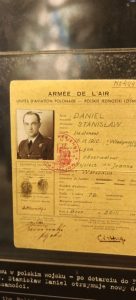
Also on display: an identity card from the French Air Force. Lieutenant Stanisław Daniel, born 16 March 1910 in Władysławowo, listed profession: observateur. A Polish pilot who reached France and was issued new papers by the Armée de l’Air. One man, two countries, multiple identities, one war. The document is yellowed, stamped in red, signed in a careful hand. He stares out from his photograph with the measured expression of someone who has learned not to give anything away.
Think about what all of this required. Not just courage but organisation. Infrastructure. Bureaucratic ingenuity deployed against a bureaucratic system of control. The Nazis weaponised paperwork. The resistance weaponised it back.
The Things People Made When There Was Nothing
This is what stopped me longest.
In a basement section of the museum, they have recreated the underground printing operations of the Warsaw resistance.
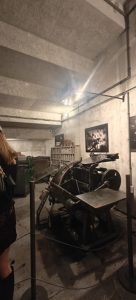
The machines are real. Actual printing presses — heavy, black, mechanical — sit in rooms that look exactly like what they were: hidden workshops where people risked their lives to publish newspapers, leaflets, and reports.
One room holds a large, paint-peeling blue press. Another, smaller and more cramped, holds compositing tables with trays of individual metal type — the letters you’d arrange by hand, one character at a time, to assemble a page. There are typesetting drawers, ink-stained surfaces, paper stacked in yellowed bundles.
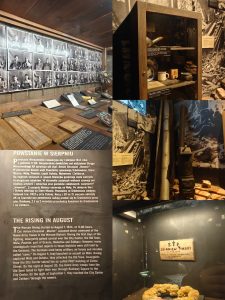
The underground press during the Warsaw Uprising was not a symbolic gesture. It was infrastructure. At the height of the Uprising, the resistance was publishing a daily newspaper. Biuletyn Informacyjny. Think about what that means — that in a city under artillery fire, with no electricity, people were setting type by hand and operating printing presses so that others could read the truth of what was happening.
Information as resistance. The word as a weapon of a different kind.
And information moved in other ways too. A panel in the museum explains the communications network of the Uprising — 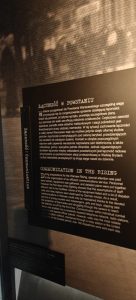 the couriers. Young men and women, boys and girls, who carried dispatches between cut-off districts by slipping past barricades, crawling through sewers, running across open streets under fire. In the busiest period, over 100 dispatches were sent each day — a relay station in the United Kingdom serving as the most reliable link.
War is often spoken of as the great accelerant of technology — and it is true that radar, jet engines, penicillin, the very architecture of the internet were all shaped by conflict. But the really profound technology in those 63 days was simpler: the decision that communication must not stop. That the truth had to keep moving. Even through the sewers.
Ingenuity Born of Desperation
The weapons on display tell a similar story — but a darker one.
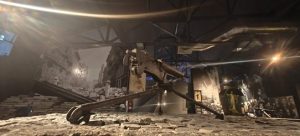
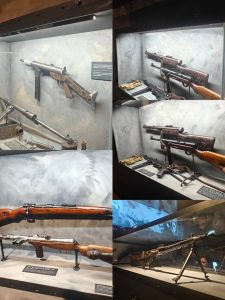
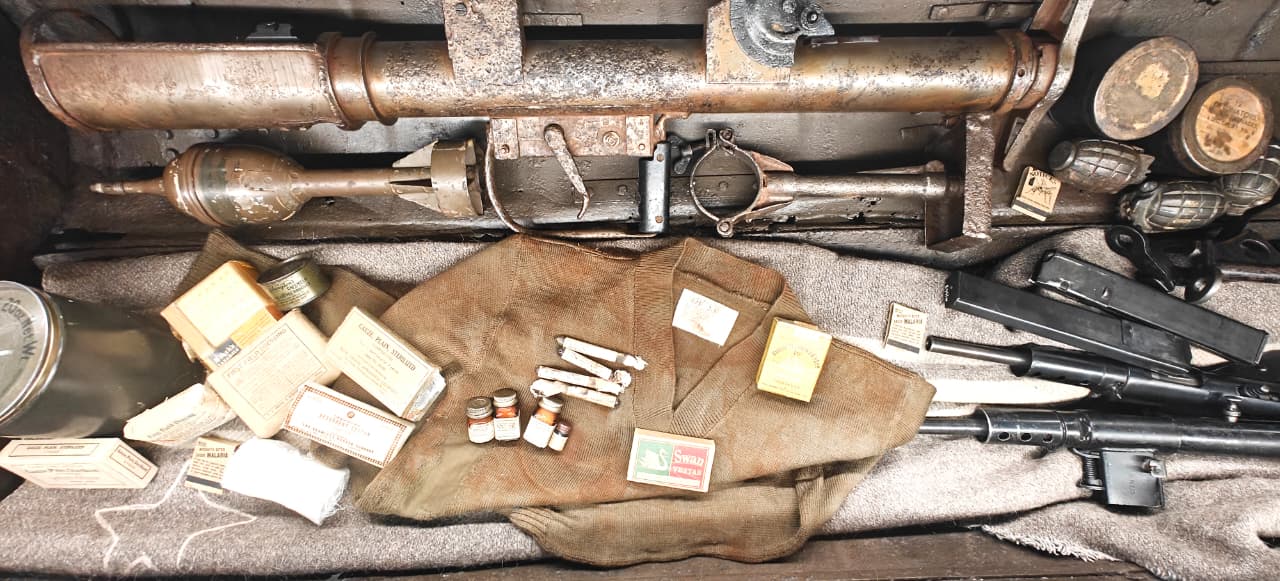
Behind glass, I saw them: pistols, submachine guns, rifles. Some captured from the Germans. Others parachuted in by the Allies. And then — the ones that are hardest to look at — the ones that were made. Right here. In hidden workshops, by engineers and metalworkers and people who had never made a weapon before in their lives.
The Błyskawica — Lightning — was a Polish-designed submachine gun, manufactured clandestinely in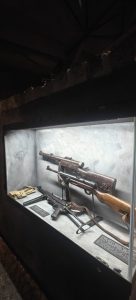 underground workshops during the occupation. It is, by any engineering measure, an elegant piece of improvised design. Alongside it: homemade grenades. Incendiary devices fashioned from bottles and scrap metal.
Above the weapons galleries, suspended from the ceiling, hangs a model of an RAF Halifax bomber. It looks almost peaceful up there — painted green, roundels on the wings, hovering as if frozen mid-flight. But what it represents is the desperate logistics of supplying a rising from the air. Allied airdrops were hampered, dangerous, and ultimately insufficient. Planes flew from Italy. Crews took enormous losses. Stalin refused to allow refuelling stops on Soviet-controlled territory. Much of what was dropped fell into German-held areas.
The Halifax hangs there as tribute and indictment both. Help that came. Help that wasn’t enough.
War does this. It compresses human ingenuity into something almost unbearable. Necessity strips away everything except the problem in front of you. And people — ordinary people — build extraordinary things.
The difference is that the large inventions get celebrated in textbooks. The small ones just sit here, behind glass, in the dark.
Letters Behind Glass
In one corner of the museum there is a display I almost walked past.
A tall glass panel, pinned with letters. Dozens of them — handwritten, folded, yellowed at the edges. Some are small, written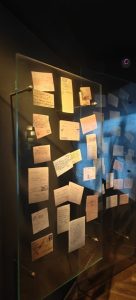 on scraps of paper. Some are longer. The handwriting ranges from careful and formal to hurried and cramped. They are letters from the occupation. Letters people wrote when they couldn’t speak freely. Letters that survived because someone kept them, folded in a pocket or hidden under a floorboard, long after the person who wrote them was gone.
You can’t read them — they’re in Polish, they’re behind glass, they’re 80 years old. But you don’t need to. You know what they say. Every letter written in a time of fear says the same thing, in the end. I am alive. I love you. I do not know what comes next.
The mundane and the extraordinary occupy the same sentence in wartime. That is what makes it so hard to look at.
A Miniature City of Ruins
There are scale models in the museum that stopped me completely.
They are meticulous recreations of what Warsaw looked like after the destruction — not the bombing, but the deliberate, methodical demolition that the Germans carried out after the Uprising capitulated. Building after building, block after block. Street after street.
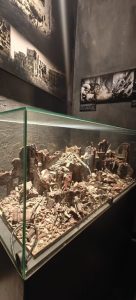
Looking at those models, you understand something that photographs cannot fully convey. The destruction of Warsaw was not collateral damage. It was not the inevitable consequence of urban warfare. It was a decision. A policy. A choice made by human beings who decided that an entire city — its streets, its churches, its libraries, its homes — should cease to exist.
Nearby, the museum displays another diorama — a different kind. Tiny figures, a Home Army ambulance truck marked AK, ruined walls, scattered brick. A scene of the city still fighting. Behind it, a collage of photographs: faces of Varsovians from 1944. Women, men, children. The faces that went through this.
And then there is the ‘City of Graves’ section. Photographs arranged in a grid — the improvised cemeteries that appeared across Warsaw during the Uprising. When people died, they were buried where they fell. In gardens. In courtyards. Under pavements. The city was too dangerous, the fighting too constant, for any other kind of burial.
Warsaw was not just a city at war. It was, simultaneously, a cemetery.
And yet. Warsaw rebuilt. Poles returned to their ruined city and rebuilt it from photographs, from memory, from paintings. The Old Town — a UNESCO World Heritage Site today — is almost entirely a post-war reconstruction. They brought it back, detail by detail, brick by brick, because the alternative was to accept that a city of a thousand years could simply be unmade.
That act of reconstruction is also, in its own way, a form of resistance.
Danuta
On a dark panel toward the middle of the museum, I found her.
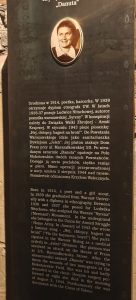 Her name was listed as ‘Danuta’ — her resistance codename. She was born in 1914. A poet. A girl scout. She graduated from Warsaw University with a degree in ethnography. Between 1936 and 1937, she had posed as the model for the Warsaw Mermaid — the Syrena monument, the symbol of the city.
When the Uprising began, she joined as a medical orderly in the Jeleń Division. Her platoon attacked the House of Press building on Marszałkowska Street. The assault failed. Danuta stayed on the field — Mokotowskie Field — trying to dress the wounds of two injured insurgents.
She was hit by a burst of fire. Wounded in the chest. Surgery was performed during the night. She died on the morning of August 2, 1944.
She was 30 years old. Posthumously awarded the Cross of Valour.
I read her story twice. Then I stood there for a moment and didn’t read anything.
There is a particular weight that comes from learning about someone like Danuta. She was a poet. She had posed for a city’s most beloved monument. She was the kind of person who, in another life, in a world where 1939 had not happened, would have lived a long and full and creative life. Instead she died on a field trying to save two strangers while a city burned around her.
War doesn’t ask who you are before it takes you.
The Wall That Kept Repeating
One panel in the museum stayed in my mind long after I left.
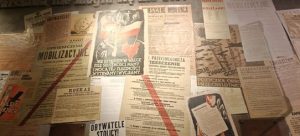
It was about ‘The Lublin Poland’ — the Soviet-backed Polish Committee of National Liberation, established on Stalin’s orders in Moscow even as the Uprising was being crushed. By the time the Soviets finally entered Warsaw, Polish communists were already setting up a parallel government, with the Soviet NKVD and the SMERSH counterintelligence units helping to eliminate the very Home Army soldiers who had fought the Germans.
Over 100 officers and soldiers of the Home Army were murdered in the castle in Lublin — the former Gestapo headquarters — simply for belonging to the Armia Krajowa.
The Poles who survived the Uprising and the German occupation found themselves inside a new occupation of a different kind. The price of liberation, it turned out, was not freedom. It was a different flag, a different set of orders, and another generation of silence.
This is the part of the story that the West largely forgot. Poland spent 45 years under communist rule before it was finally, genuinely free. The Warsaw Uprising — which could have been the moment of liberation — was in some ways the beginning of another chapter of suffering.
History is rarely a straight line. It circles.
And yet even during those 45 years, the memory refused to die. Every year on August 1, crowds gathered at the Powązki Military Cemetery, at the Gloria Victis monument, families coming together to lay flowers and light candles for the fallen insurgents. The Communist government tried to suppress the Uprising’s memory — it was inconvenient, proof that Poles had fought for a free Poland that the Soviets then denied them. But memory, like water, finds its way through.
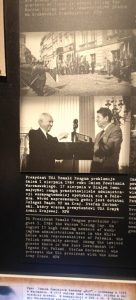
In 1984 — forty years after the Uprising — US President Ronald Reagan proclaimed August 1 as Warsaw Rising Day. A photograph in the museum shows Stefan Korbońsk, the last Government Delegate for Poland-in-Exile, presenting Reagan with the Home Army Cross at the White House. What it represents is significant: someone in the West finally said the name out loud, on the record, and meant it.
Memory kept alive across forty years of official silence. That is not a small thing.
Why Museums Like This Exist
There are many museums where history is kept — the Apartheid Museum in Johannesburg, the Hiroshima Peace Memorial, Auschwitz-Birkenau, the 9/11 Memorial in New York. Each of them asks you something different. Each of them changes you a little.
The Warsaw Uprising Museum is not an accusation. It is not a memorial of grievance. Poland and Germany today have normal diplomatic relations. Germans come to this museum. I saw young German tourists in the galleries, reading the same panels I was reading. Nobody was pointing fingers. Nobody needed to.
That is what 80 years looks like. The enemies of 1944 are now neighbours, partners, fellow Europeans. The grandchildren of those who gave orders and those who obeyed them, and those who resisted them, now travel freely between Warsaw and Berlin.
And yet the museum exists. And it should exist. Because without it, the story disappears. And when a story disappears, something essential about humanity disappears with it.
This is why nations tell their stories to their children. Not to teach them hatred. Not to nurse grievance. But to ensure that the names — Danuta, and the thousands like her — don’t evaporate into the fog of time. So that the choices made in those 63 days remain legible. So that the next generation understands what it cost. What everything cost.
A nation is built not just from roads and constitutions and economies. It is built from stories. From the specific, irreducible weight of what actually happened. That is what this museum does. It holds the weight. It refuses to let it become lighter than it should be.
What I Carried Out
I stood for a while in one of the galleries, in front of a wall that displayed the underground resistance press. Behind me was a photograph of young insurgents holding a flag with the Polish eagle. To my right, documents. To my left, more faces on more panels.
I thought about what it means to visit a place like this as an outsider. As someone from a country that has its own layered, unresolved history of occupation and resistance, of partition and rebuilding, of stories told and stories suppressed. The Warsaw Uprising is not my history. And yet something about it felt deeply, uncomfortably familiar. The shape of it. The way a people can be squeezed from both sides and still find a way to say: we are here.
I thought about the printing presses in the basement. About people setting type by hand so that the truth could exist on paper. About weapons made from scraps by hands that were probably shaking. About a poet who posed for a mermaid and then went to war and didn’t come back. About a boy carrying a dispatch through a sewer under a burning city. About a pilot flying a Halifax from Italy with barely enough fuel to make it home.
I thought about what it means to fight for something when there is genuinely no guarantee that you will win. When the calculus isn’t favourable. When the world’s great powers have other priorities. When the army you were counting on stops on the other side of a river.
The Warsaw Uprising, militarily, failed. The city was destroyed. The free Poland the fighters were trying to create didn’t arrive for another 45 years. By any conventional measure, it was a defeat.
And yet here is Warsaw. Rebuilt. Full of people. Cafes and bookshops and children on bicycles. A city that was once deliberately erased — alive.
There is a lesson in that. I’m not entirely sure I can put it into words. But I felt it, standing there in the gallery, with history pressing in on all sides.
Some things that should not have survived, survive anyway. And the people who refused to let them die — even when it cost them everything — deserve to be remembered.
Not forever, necessarily. But for a long, long time.
*******************************
If you are visiting Warsaw, the Uprising Museum is not optional. Block a full half-day. Go slowly. Read everything. And give yourself some quiet time after… you will know freedom is not free and what is the cost of war …