
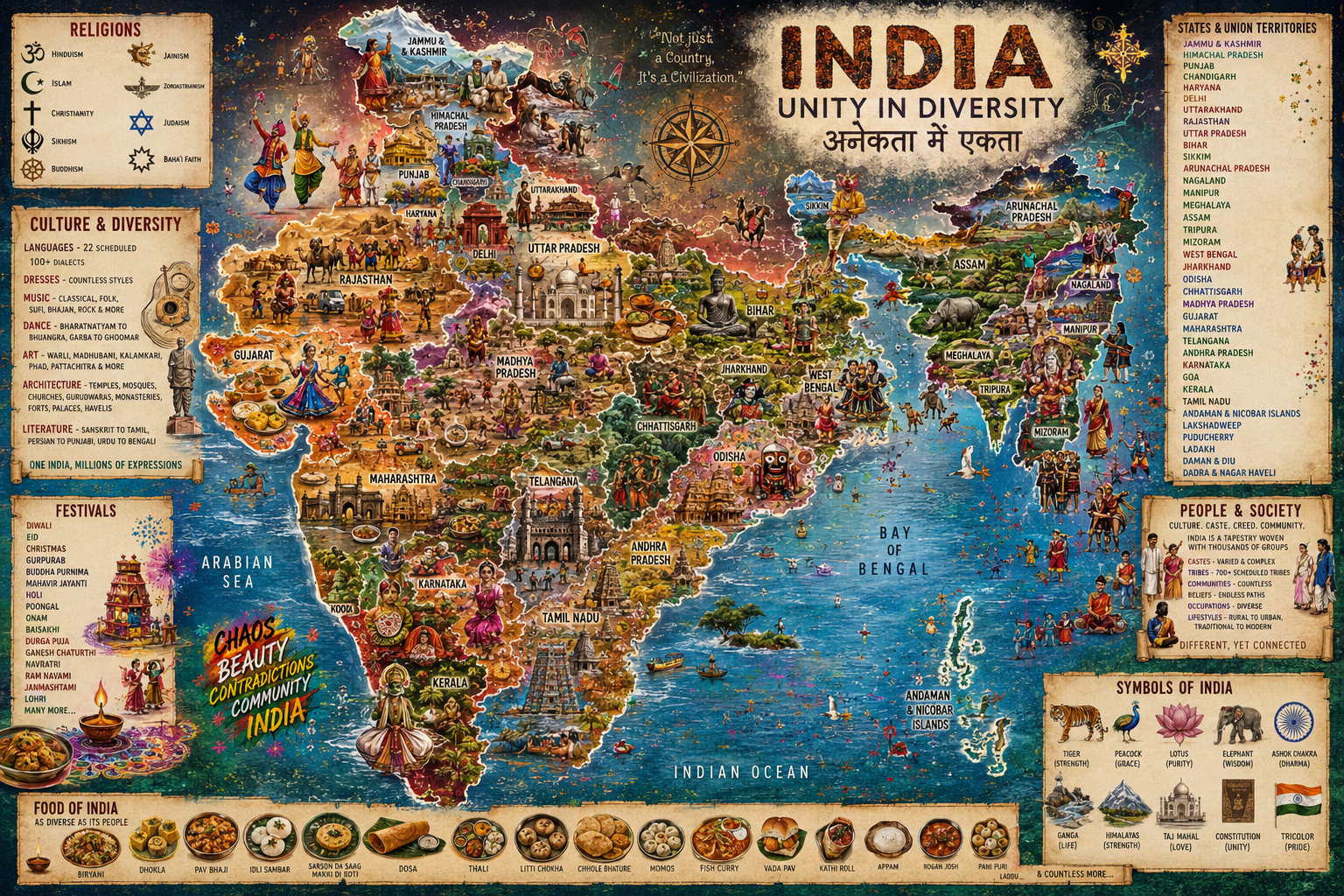
To Understand India, You Must First Unlearn the Idea of a Country
There is a particular kind of question that is asked of India in foreign press rooms, and it always lands with the same weight. Yesterday it was asked again in Oslo, when a Norwegian journalist wanted to know why India should be trusted and what about the human rights violation. The day before, in The Hague, a Dutch journalist had pressed a similar point. And in the briefing that followed at our own Ministry of External Affairs, Secretary (West) Sibi George responded with a phrase that has stayed with me — that such questions reflect “the lack of understanding of the person” asking.
While I do not want to repeat the replies of Sibi George or how befitting those replies were (or were not), I want to sit with that phrase for a while, because I think it is more important than the political moment that produced it. The question is not whether the journalist had the right to ask. She did, and asking difficult questions of power is precisely what a free press is for. The deeper question is – whether the frame inside which she asked — the frame inside which most Western coverage of India is written — is large enough to hold what India actually is.
I do not think it is. And I think the reasons why it is not are worth examining slowly, because they tell us something about how civilisations come to be misunderstood, and about how much work remains to be done before India is read on its own terms rather than on terms borrowed from elsewhere.
The country that cannot be read in a hundred years
India is not a country in the sense that Norway is a country, or the Netherlands, or any of the neat, contained nations of Europe. To understand India through the lens of a fifty-year democratic experiment, or a hundred-year colonial wound, or even a two-hundred-year constitutional arc, is to read only the last page of a book that runs to five thousand. You will know how the story ends, but you will have no idea what it was about.
This is not a defensive claim. It is a structural one. The civilisations of Europe organised themselves, over centuries, around a great simplification — one dominant faith, one language community per nation-state, one set of dietary habits, one broad way of being. The modern European country is, in many ways, the architectural triumph of uniformity. It is a remarkable achievement, and I do not say that with irony. The clarity of a Norwegian town, the legibility of a Dutch street, the cultural confidence of a Parisian neighbourhood — these are real things, hard-won.
But that clarity becomes a blindness when it is turned towards India. Because the Indian civilisational project is the exact opposite. It is the project of holding the plural together without erasing it.
Consider the arithmetic alone. India has twenty-two officially recognised languages and around a hundred and twenty more spoken by significant populations. We are home to every major world religion, including the four that were born on this soil — Hinduism, Buddhism, Jainism, and Sikhism — and significant populations of Muslims, Christians, Zoroastrians, and Jews who have lived here, in some cases, for longer than they have lived anywhere else. A Parsi family in Mumbai is descended from refugees who arrived in the eighth century, given sanctuary when their faith was hunted to extinction elsewhere. The oldest synagogue in the Commonwealth is in Kochi. The Syrian Christians of Kerala trace their faith to the apostle Thomas, who is believed to have landed on the Malabar coast in the first century — meaning Christianity took root in India before it reached most of Europe.
Now imagine asking a country built on uniformity to make sense of this. Imagine explaining, to someone whose mental model of a “nation” requires a single people, that a north Indian and a south Indian share less linguistic kinship than a Norwegian and a Greek, and yet feel themselves to be one people. That a Bengali, a Tamil, a Kashmiri, and a Naga eat differently, dress differently, worship differently, marry differently, mourn differently — and still, somehow, walk under the same flag without the whole arrangement collapsing.
This is not a tidy story. It was never going to be. The miracle is not that India sometimes struggles with its plurality. The miracle is that the plurality holds.
What Hinduism actually is
If there is a single concept that gets more flattened in international coverage than any other, it is Hinduism. So let me try, in plain language, to say what it is and what it is not — because almost every external argument about Indian politics rests on a model of Hinduism that any thoughtful Hindu would struggle to recognise.
Hinduism is not, in any meaningful sense, a religion of the Abrahamic kind. It has no single founder. It has no central prophet. It has no governing church. It has no single binding scripture — the Vedas, the Upanishads, the Bhagavad Gita, the Puranas, the great epics of the Mahabharata and the Ramayana, all sit together as part of a vast library, not a closed canon. It has no religious authority that can excommunicate you, no equivalent of the Pope or the Caliph, no body that decides who is in and who is out. A Hindu can be polytheistic, monotheistic, pantheistic, monistic, agnostic, or atheistic, and still be considered a Hindu. The Charvaka school, which flourished within the Indian tradition for centuries, was openly materialist and rejected the very idea of an afterlife — and was still treated as part of the family of Indian philosophies.
Scholars usually identify four broad denominations within Hinduism — Vaishnavism, Shaivism, Shaktism, and Smartism — and six classical schools of philosophy, including the Vedanta and Yoga schools that have travelled most widely. But within these are thousands of sampradayas, lineages, regional traditions, village deities, household practices, and personal forms of devotion. A Tamil grandmother’s morning prayer, a Bengali Durga Puja, a Vaishnava chanting in Mathura, a yogi in a Himalayan cave, a sceptical professor in Delhi who lights a lamp on Diwali out of habit and affection — all of these are Hinduism. And none of them is the whole of it.
The closest thing Hinduism has to a unifying concept is dharma, which is almost untranslatable but means something like “the right way of being in the world” — your duty to your role, your family, your work, your conscience, the cosmic order. Dharma is contextual. What is right for a soldier is not right for a monk. What is right at one age is not right at another. There is no single commandment to follow. There is the harder, slower task of working out what your dharma is, in your circumstances, in your life.
This is why the Hindu tradition has historically not been a missionary tradition. There is no equivalent of “go forth and convert,” because there is no single truth that you are required to bring to others. The Rig Veda contains the line Ekam sat vipra bahudha vadanti — “Truth is one, the wise call it by many names” — and this is not a marginal sentiment. It is a foundational disposition. It is why, when Jews fled persecution and arrived in India, no one tried to convert them. It is why the Parsis were welcomed and allowed to keep their faith intact. It is why Buddhism and Jainism could arise from within the same civilisational soil, disagree fundamentally with Vedic ritual, and still flourish without being branded heresies and crushed.
This is the Hinduism that most thinking Hindus practise and recognise. It is philosophical, pluralistic, sceptical of dogma, and tolerant by structural disposition rather than by political effort. It is also, for that very reason, almost impossible to render accurately in a thousand-word news article written from a desk in London.
The lenses through which India is now read
What gets exported instead is a series of lenses, each refracting India through its own preoccupations, each correct in a small way and wrong in a large one.
There is the colonial lens, inherited and rarely examined, which assumes that India was made coherent by the British, that its democracy is a Westminster gift, and that any deviation from a recognisable Anglo-European model is a kind of regression. Inside this lens, India is always failing to live up to a standard set elsewhere. It is never simply doing something different.
There is the Western liberal lens, which treats Hinduism as if it were a confessional religion like Christianity — and therefore reads any cultural reassertion of Hindu identity as the equivalent of Christian fundamentalism. The categories do not transfer. A Hindu speaking of dharma in public life is not making the same move as an American evangelical demanding prayer in schools, but the international press, lacking other categories, reaches for the only template it has.
There is the geopolitical lens, in which India is read primarily as a strategic chess piece — useful as a counterweight to China, suspect when it buys Russian oil, scolded when it refuses to align fully with Washington’s preferences. Inside this lens, India’s autonomy is itself the problem. A country that will not pick a side is treated as a country that has not yet matured.
There is the cross-border lens. India’s immediate neighbourhood includes states whose national identity has, for decades, been organised partly around opposition to India. A great deal of international commentary on Kashmir, on minority rights, on Indian foreign policy is shaped — directly or indirectly — by narratives that originate in this neighbourhood and are then laundered through sympathetic think tanks, lobbying networks, and diaspora pressure groups before they appear, stripped of their origin, in respectable Western outlets. This is not a conspiracy theory. It is documented. It is how information environments work everywhere, and India is no exception.
And there is, honestly, the diaspora lens — the contribution of a particular kind of Indian intellectual who built a career abroad by explaining India to the West, and who, in doing so, often adopted the categories the West was most comfortable hearing. Some of this work is brilliant and necessary. Some of it has, over time, calcified into a particular reading — secularism as a Western import, Hinduism as inherently regressive, any cultural confidence on India’s part as suspect — that is then re-exported as authoritative because it carries an Indian name. The result is that an Indian reader can pick up a Western newspaper, find an essay on India written by an Indian, and barely recognise the country being described.
I want to be careful here. Domestic criticism is not betrayal so to say. Indians who disagree with their government, who write hard things about caste, about communalism, about the failures of Indian democracy sometimes in some way, are doing exactly the work a healthy society needs. A civilisation that cannot tolerate self-criticism is a civilisation that has stopped thinking. The problem is not that Indians criticise India. The problem is that the international image of India is now built almost entirely from one particular slice of that criticism, amplified far beyond its share of Indian opinion, while the deeper civilisational picture — the one I have tried to sketch above — is rarely translated for foreign readers at all.
So a Norwegian journalist arrives at her press conference with a head full of frames she did not choose. The colonial frame, the liberal frame, the geopolitical frame, the cross-border frame, the diaspora frame. And then she asks her question, in good faith, and the answer she receives sounds defensive, because no honest answer could fit inside the question as asked. And if someone really wants to answer that question, he has to start from the very beginning of human civilization, which is impossible.
The press freedom problem, taken seriously
I do not want to dodge the specific charge. Norway sits at number one on the World Press Freedom Index. India sits at one hundred and fifty-seven. That is a fact, and it is not flattering. Indian journalists have been jailed, harassed, and sued under colonial-era sedition laws and newer information technology laws. The Prime Minister has not held an open domestic press conference of the unscripted kind in over a decade. These are real concerns and they deserve real answers.
But the answer is not, I think, the one most Western commentators reach for — that India is sliding into authoritarianism on a recognisable Western model. The answer is more complicated. India’s relationship with its press has always been a contested one, even under the Congress governments of the past, even during the Emergency of 1975 when the press was openly muzzled by a self-described secular liberal regime. The pressures on Indian journalism today are real, but they sit inside a much longer pattern, and they coexist with one of the most rambunctious, multilingual, decentralized media ecosystems in the world. There are thousands of newspapers in dozens of languages, television channels of every political persuasion, and a digital press that, for all its problems, is wildly diverse.
This does not excuse the constraints. It frames them. It is the difference between saying “India has problems with press freedom” and saying “India is becoming an authoritarian state” — which is the framing that often gets applied and which most Indians, including most Indian critics of the government, would not recognise.
The human rights question, and the asymmetry of scrutiny
The other charge raised at the Oslo press conference was human rights. This too deserves a slow, honest answer, because the framing matters as much as the facts.
Let me begin with a single case that almost every Western commentator on Indian human rights manages to leave out. In November 2008, ten gunmen trained and dispatched from Pakistan attacked Mumbai over four days, killing 166 people at a railway station, two five-star hotels, a Jewish centre, a hospital, and a café. Nine of the attackers were killed. The tenth, Ajmal Kasab, was captured alive on a Mumbai street, on camera, mid-massacre. He was a foreign national, a self-confessed terrorist, caught in the act of mass murder.
What India did next is the part that matters.
It gave him a trial. It appointed him a defence lawyer at state expense — the first lawyer assigned refused on conscientious grounds and the court appointed another. The trial ran for over a year, from 2009 to 2010, in a special court inside Arthur Road Jail. He was charged with 86 offences. He was convicted in May 2010. The Bombay High Court reviewed the conviction and confirmed it in February 2011. He appealed to the Supreme Court of India, which in August 2012 examined the case in detail and upheld the verdict. He then filed a mercy petition to the President of India under Article 72 of the Constitution. The petition was processed, debated, and rejected. He was executed in November 2012 — four years after his capture, after every single layer of Indian due process had been exhausted.
A man caught on camera murdering civilians at a railway station received four years of legal process in the country whose citizens he had killed. I would invite anyone who believes India is a serial violator of human rights to find me a comparable case — any case, anywhere — where a captured foreign terrorist received the same constitutional patience from any of the countries currently doing the lecturing.
The United States held men at Guantánamo Bay for two decades without trial, including men against whom no charges were ever filed. The United Kingdom rendered terror suspects to be tortured in third countries under its “extraordinary rendition” arrangements. France imposed an extended state of emergency after the 2015 Paris attacks that allowed warrantless searches and house arrests on administrative order. These are not whispered allegations. They are documented, public, and largely unrepented. And yet the same press that ran them as page-three items writes front-page editorials when a single Indian incident, terrible as it may be, makes the news.
Now widen the frame further. In the twentieth century alone, Belgian rule in the Congo killed an estimated ten million people. British administration during the Bengal famine of 1943 caused the deaths of three million Indians while wartime grain was diverted to feed troops elsewhere. French Algeria, Dutch Indonesia, Portuguese Mozambique — the body counts of European colonial rule are not contested numbers in serious scholarship. They are simply not part of the moral ledger when Europe assesses India today. The continent that organised the largest sustained programme of violence in modern history now grades India on its conscience.
Look closer to home. In Pakistan, the Hindu population has fallen from around 23 per cent of the territory in 1947 to under 2 per cent today — a collapse of more than 80 per cent in three generations, driven by violence, forced conversion, abduction of women and girls, and systematic exclusion. In Bangladesh, the Hindu share has fallen from around 23 per cent in 1951 to under 8 per cent by 2022 — the United States Commission on International Religious Freedom has documented hundreds of cases each year of killings, rapes, kidnappings, and attacks on temples and homes. India, over the same period, has seen its Muslim population grow from around 10 per cent in 1951 to over 14 per cent today, with continuous representation in parliament, the courts, the civil service, the armed forces, the film industry, and three of the seventeen Presidents of India having been Muslim. These are simply facts. They may not absolve India of its own failings fully, but they make a particular kind of comparison impossible to sustain in good faith.
Look at the West’s own present, not just its past. The United States is in the eighth decade of a continuous, documented argument with itself about the killing of unarmed Black citizens by its own police, and about voting rights, and about who is allowed to enter the country. Europe ran refugee camps on Greek islands that human rights organisations have repeatedly compared to detention facilities. The United Kingdom continues to deport asylum seekers under arrangements its own courts have repeatedly struck down. Australia held asylum seekers offshore for years. These are not historical wounds. They are ongoing. And they do not, in the Western press, attract the same vocabulary of civilisational failure that gets reached for when India is the subject.
I want to be clear about what I am and am not saying. I am not saying India has no human rights problems. India has the problems of a country of 1.4 billion people, twenty-eight states, hundreds of languages, every major religion, sharp economic inequality, and a security environment that includes two hostile nuclear neighbours and active terrorist networks. There are lynchings. There are custodial deaths. There are anti-conversion laws applied with uneven hands. There are journalists who have been jailed under laws that should not exist in their current form. These are real, and they should be argued about, in India, by Indians, and they are — vigorously, in courts, in parliament, in our own newspapers, in the streets.
What I am saying is that the intensity and selectivity of international scrutiny applied to India is wildly disproportionate to the actual record. A country that gives its captured terrorists four years of constitutional due process; that has elected Muslim Presidents and Sikh Prime Ministers and Christian Defence Ministers; that has held seventeen general elections in seventy-seven years without a single military coup; that absorbed fourteen million displaced people at Partition without becoming an ethnostate; that has a free judiciary which routinely rules against its own government — this country is being graded, by outlets and institutions whose own civilisational record is far bloodier and far more recent, as if it were a junior delinquent on probation.
You can hold India to a high standard. We hold ourselves to a high standard. That is fair. But you cannot hold India to a standard that you do not apply to yourselves, that you do not apply to its neighbours, that you do not apply to your own history, and then call the result objective journalism. That is not scrutiny. That is selection.
The responsibility on our side
But I do not think the responsibility lies only with the foreign observer. Much of the misunderstanding is our own fault. We have not done the work of explaining ourselves to the world. We assume that our complexity is self-evident. It is not. We assume that anyone who reads our history will arrive at the same affection we feel for it. They will not, unless we write that history in languages they can read, in forms they can absorb, in voices they can trust.
The Chinese have been quietly building soft-power infrastructure — Confucius Institutes, state-funded English-language media, cultural festivals — for thirty years. The Koreans have, almost without trying, exported their entire culture through music and television and food. The Japanese spent the second half of the twentieth century making themselves legible to the world through design, literature, and cinema. India, with arguably more to say and certainly more to draw from, has done remarkably little of this in a coordinated way. We have produced Bollywood, yoga, and the occasional Booker Prize winner, and we have assumed the rest would explain itself.
It will not. And the cost of not explaining is exactly what we are watching now: a country of 1.4 billion people, with one of the oldest continuous civilisations on the planet, being read through frames designed for somewhere else, by journalists who have read three books about it, advised by experts whose own framing is twenty years out of date.
This is the work I think every Indian writer, journalist, designer, businessman, and diplomat carries quietly on their shoulders, whether they have signed up for it or not. Every conversation with a European colleague, every email to a Scandinavian client, every panel at an international conference, every blog post like this one — these are small acts of translation. They are how a civilisation explains itself.
We need more of them. In every journal, every magazine, every newsroom, every design studio. Not defensive, not aggrieved, not nationalist in the narrow sense — but patient, generous, and confident. Confident enough to say: yes, we have our problems, and we will work on them in our own time and in our own way, but please do not mistake our slowness for failure, please do not mistake our complexity for chaos, and please do not mistake our pluralism for a more familiar kind of secularism that we then keep failing to live up to.
The medium has changed. The story must catch up.
And here is the part that should worry us most. The generation now forming its first impressions of India is not reading those three books. It is not reading the BBC, or the long-form pieces written in India’s defence, or even the essays of the Indian intellectuals it disagrees with. It is learning India in fifteen-second fragments — on TikTok, on Instagram Reels, on YouTube Shorts, from Wikipedia summaries written by anonymous editors, from a single viral thread on X, from the algorithmic drift of a Facebook feed on a Sunday afternoon. A child in Oslo or Stuttgart or São Paulo is forming an opinion of India today not from books or newspapers but from a stitched-together impression of half a dozen reels: a temple, a stampede, a wedding, a slum, a saffron flag, a clip of a politician shouting. Whatever sticks, sticks. And what sticks is shaping a worldview that will harden into adulthood.
This is a different medium, and it asks for a different discipline. The reflective essay, the considered op-ed, the carefully researched book — these still matter, and I would never argue otherwise. But they cannot, on their own, do the work of cultural translation any more. If India’s story is not being told in the format that the next generation actually consumes, in the rhythms it actually responds to, in the visual grammar it already speaks — then we are losing the argument in a room we have not even entered.
Look at how Korea did this. Korean food, Korean television, Korean music, Korean fashion — none of it was sold to the world as a lecture on Korean civilisation. It was packaged as something young, watchable, repeatable, shareable. By the time you have watched your tenth K-drama and eaten kimchi twice in a month, you have absorbed a worldview without anyone teaching it to you. That is soft power in the modern key. It does not argue. It accumulates.
India has the raw material in abundance — more than abundance. A thousand festivals. A hundred classical dance forms. A vegetarian cuisine that the global wellness industry is already rediscovering. A street food tradition that puts most cuisines to shame. The most diverse wedding cultures on earth. An explosion of regional cinema that goes well beyond Bollywood. Classical music traditions that survived a millennium. Textile traditions older than most European nations. Design vocabularies and craft traditions that contemporary studios in Copenhagen and Milan are quietly drawing from. Every single one of these is a short-form story waiting to be told. Every village has a reel in it. Every grandmother has a thread in her. The material is not the problem. The translation is.
What India needs is not more press releases. It needs more storytellers — creators, photographers, videographers, designers, chefs, dancers, archivists, ordinary people with phones and a sense of how their world looks to someone who has never seen it. We need them telling our story in the languages and formats the world is actually watching, with confidence and without apology, without waiting for permission and without flinching from complexity. A reel of a Kerala mosque next to a Kerala temple next to a Kerala church, with the same priest’s grandson making coconut chutney in all three, will do more to correct the international image of India than a thousand defensive op-eds. Because that is the India most of us actually live in. We just have not been showing it.
The old way of telling a country’s story was to write a book and hope the right people read it. The new way is to make the country visible — frame by frame, plate by plate, festival by festival — until the world cannot help but see it. India will have to do both. The book and the reel. The essay and the short. The deep and the swift. Anything less, and we will keep handing our story to people who do not know it well enough to tell it right.
The longer view
I keep coming back to the image of the Norwegian journalist at the elevator, the doors closing on her question. It is, in some ways, a perfect tableau. A question asked across a gap that neither side fully knows how to bridge. Both parties acting in good faith, by the lights of their own tradition. Both parties leaving the encounter convinced the other did not quite understand.
That gap is the real story. And it will not be closed by one press conference, or one good answer, or one heated rebuttal. It will be closed, slowly, by the long, unhurried work of writers and readers, traders and travellers, designers and diplomats, choosing to take each other’s civilisations seriously. By Indians learning to explain themselves without sounding either apologetic or shrill. By Western journalists learning to ask about India with the same humility they would bring to Japan or to Iran or to any other ancient culture whose categories are not their own. By all of us agreeing that a five-thousand-year-old civilisation deserves more than a two-thousand-word news cycle.
Five thousand years is a long time. India can afford to wait. But it cannot afford to stay silent.