
Piyush goyalu
An Open Letter to Mr. Piyush Goyal
Dear Mr. Piyush Goyal,
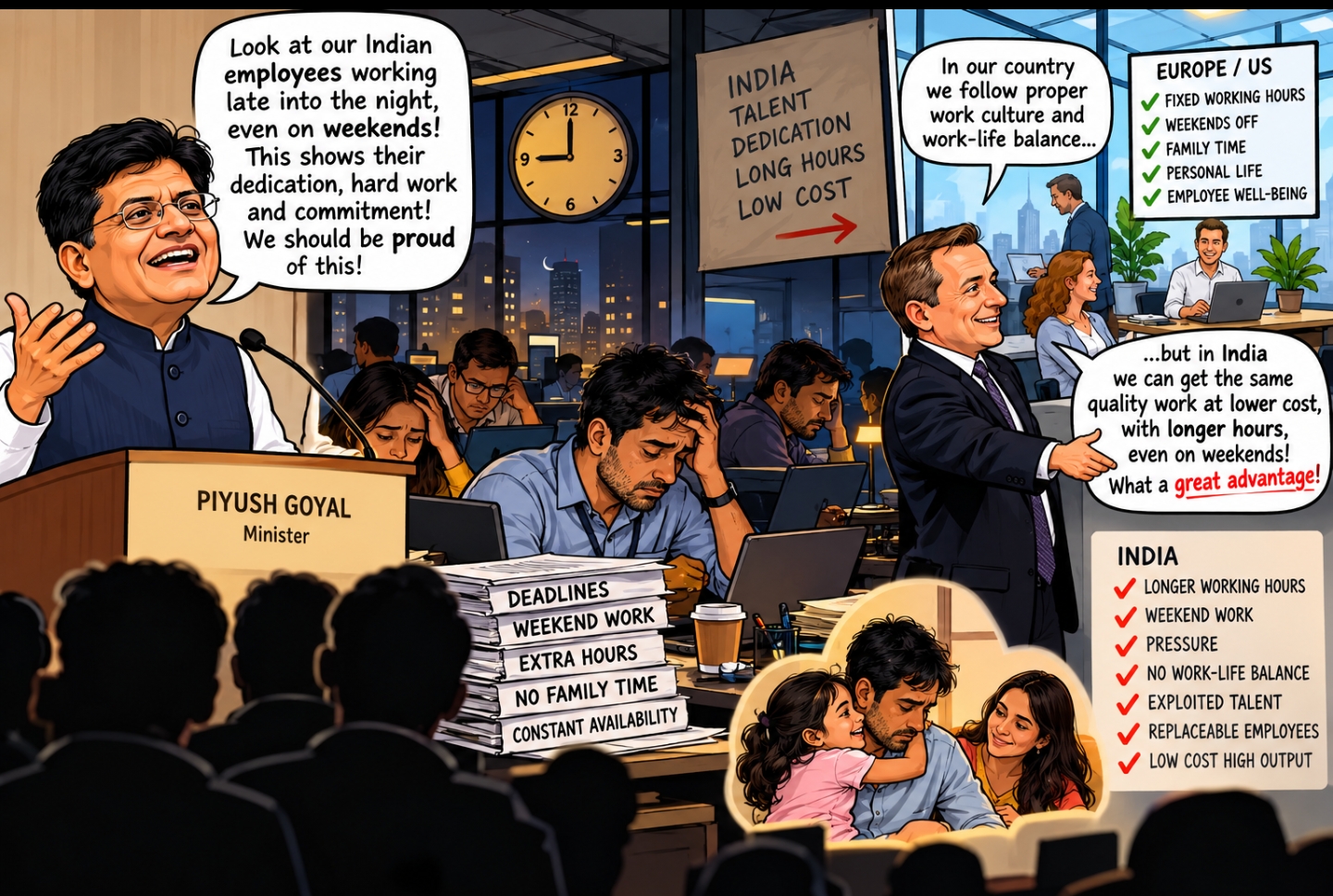
It is deeply unfortunate to see the working conditions of Indian employees being spoken about in a manner that appears to celebrate their exploitation rather than question it.
When employees are working in offices until 8 pm, 9 pm, or even later, when their weekends are routinely consumed by work, and when personal and family commitments are sacrificed at the altar of corporate expectations, what exactly are we celebrating?
Their dedication? Their ambition? Their willingness to work hard?
Or are we simply normalising a culture in which an employee’s willingness to sacrifice everything becomes an excuse for an employer to demand even more?
Working late is not necessarily a sign of productivity. Working weekends is not a badge of honour. And sacrificing family life is certainly not a measure of professional success.
What makes this situation particularly disturbing is the double standard followed by many multinational companies. In their home countries, these organisations often operate within established working-hour norms, respect employees’ personal time, and recognise the importance of work-life balance. Yet, in India, employees can find themselves facing unreasonable deadlines, extended working hours, weekend assignments, and an unspoken expectation to remain available at all times.
Why should the same company have one standard for its employees in Europe and another for its employees in India?
Does an Indian employee’s time have less value? Does their family deserve less attention? Is their need for rest, recreation, and a life beyond the office any less legitimate?
The problem is not that Indian employees are willing to work hard. The problem is when their willingness to work hard is mistaken for permission to exploit them.
The glorification of overwork must stop
Weekends are meant to offer people an opportunity to rest, reconnect with their families, pursue their interests, travel, read, explore, or simply do nothing. These are not privileges reserved for people working in developed economies. They are fundamental aspects of a dignified life.
When a senior political leader speaks positively about employees working late into the night or giving up their weekends, the message can have consequences far beyond a speech or a public statement.
It risks reinforcing the belief that long hours are desirable, that constant availability demonstrates commitment, and that an employee who sets boundaries is somehow less dedicated.
The implications are serious.
Managers may feel encouraged to demand more. Companies may feel justified in extending working hours. Employees may become increasingly reluctant to say no, fearing that doing so could affect their appraisals, promotions, or even their jobs.
And those who are already struggling in an intensely competitive job market may feel they have no choice but to comply.
That is not a healthy work culture. It is a culture built on unequal bargaining power.
Is this the price Indians must pay for employment?
India has a large, ambitious, talented workforce. Our professionals contribute enormously to the success of global businesses. Indian employees are managing international operations, building technology, serving customers across time zones, developing products, and generating substantial value for their employers.
They deserve recognition for their contributions.
But we must ask ourselves an uncomfortable question:
Are we attracting global businesses because India offers exceptional talent, or are we increasingly being encouraged to compete by offering our time, our personal lives, and our well-being at a discount?
If a company can maintain reasonable working practices in its home country but expects its Indian employees to work late into the night and sacrifice their weekends, we must question the corporate culture that permits this disparity.
And if our public representatives celebrate such practices instead of questioning them, we must question the message being sent to employers.
India should compete on the strength of its talent, innovation, productivity, skills, and business environment. We should not compete by demonstrating how much hardship our workforce is prepared to tolerate.
Where is the protection for employees?
India needs a serious and honest conversation about working hours, overtime, the right to disconnect, and the enforcement of labour protections.
To be clear, Indian labour laws are not entirely absent. Working-hour limits, overtime provisions, weekly rest requirements, and other protections exist under various central and state laws, depending on the sector, establishment, and applicable legislation. But the existence of laws on paper is not enough. Their effective implementation matters just as much.
When employees feel compelled to work beyond reasonable hours, when weekend work becomes routine rather than exceptional, and when refusing additional work carries the risk of professional consequences, the question is not merely whether a rule exists.
The question is whether an employee can realistically exercise their rights without fear.
We need stronger enforcement of applicable labour laws, transparent overtime policies, meaningful weekly rest, accountability for unreasonable work demands, and serious consideration of a right to disconnect outside working hours.
We must also recognise that working long hours does not automatically translate into higher productivity. Exhaustion, stress, deteriorating relationships, and burnout carry costs for individuals, families, organisations, and society.
A country cannot build a genuinely prosperous workforce by exhausting the very people whose productivity it seeks to increase.
Employment should provide dignity, not become paid slavery
Let us be honest. Many employees do not work late because they particularly enjoy spending their evenings in an office. Many do not give up their weekends because they believe it is the ideal way to live.
They do it because they need their jobs.
They have EMIs to pay, children to educate, parents to support, and families whose financial security depends on their income. In an uncertain job market, refusing unreasonable demands can feel like a risk they cannot afford to take.
This is where the imbalance of power becomes most visible.
When the choice appears to be between protecting one’s personal life and protecting one’s livelihood, how free is that choice really?
Calling this a culture of dedication does not change the underlying reality. When excessive demands become routine and employees feel they cannot refuse, dedication can become a convenient label for exploitation.
A salary is compensation for work. It is not the purchase price of a person’s entire life.
An employee’s contract does not erase their identity as a parent, spouse, child, friend, or individual with ambitions and interests beyond their profession.
They have a life outside the office. They have people waiting for them at home. They have a right to spend time with their families without feeling guilty about it.
That should not be a radical idea in a country aspiring to become a global economic powerhouse.
What should our leadership be celebrating?
Mr. Goyal, if we want to celebrate Indian employees, let us celebrate the right things.
Let us celebrate companies that achieve outstanding results without exhausting their people.
Let us celebrate workplaces where productivity is measured by the quality and impact of work, not by the number of hours an employee remains at their desk.
Let us celebrate organisations that respect family commitments, encourage employees to take their leave, compensate overtime fairly, and understand that rest is essential to sustained performance.
Let us celebrate Indian professionals who are ambitious without being forced to choose between career advancement and a meaningful personal life.
And let us celebrate a country where a young professional can aspire to success without believing that success requires surrendering every evening and weekend to an employer.
As a minister, your words carry influence. They can shape public attitudes, affect corporate expectations, and influence how the next generation understands professional success.
That influence comes with a responsibility.
Instead of celebrating how late Indian employees are willing to work, we should be asking why they need to work so late in the first place.
Instead of applauding weekend work, we should be asking whether it is genuinely necessary, properly compensated, and consistent with applicable labour protections.
Instead of presenting sacrifice as a virtue in itself, we should be demanding workplaces where people can perform well and still have a life.
India does not need a workforce that is proud of being overworked. India needs a workforce that is respected, protected, fairly compensated, and empowered to live with dignity.
Dear Mr. Goyal, Indian employees are not asking for the freedom to avoid work. They are asking for the freedom to work hard without being made to feel that their lives belong to their employers.
They want to contribute to India’s growth. They want to build successful careers. They want better incomes and better opportunities for their families.
But they also want to see their children grow up, spend time with their ageing parents, enjoy a weekend, pursue a passion, travel, and occasionally come home from work while there is still time left in the day.
Is that too much to ask?
A nation that wants to be a global economic leader must understand that its greatest asset is not a workforce willing to endure unlimited hours. It is a workforce that is healthy, motivated, productive, and treated with dignity.
Let us stop celebrating overwork. Let us start demanding better work.
Because economic progress that comes at the cost of human dignity is not progress worth celebrating.
And paid employment must never become a socially accepted form of slavery.
An Indian employee’s time, dignity, and family life are worth just as much as those of any employee anywhere else in the world.
*********
The views are entirely mine and don’t have any kind of relation to or influence from any other person or source or organisation.